The Heart of Antarctica: Exploring the Southern Continent by Land
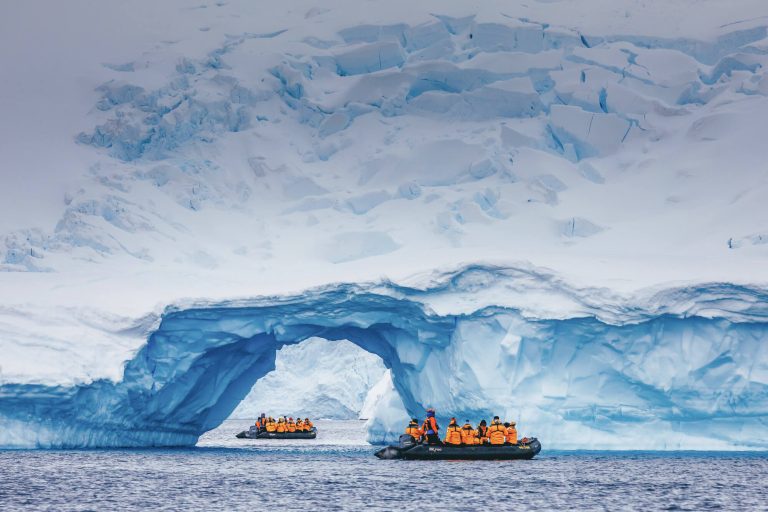
The great white continent, a visit to Antarctica is frequently listed by travellers as a top travel experience. Blessed with long summer days which carry the temperature to a comfortable degree and teeming with wildlife, an Antarctic voyage is an ideal trip with plenty of departures to choose from during the summer months of November to March. But many people aren’t aware that you can do more than just explore this mysterious continent by cruise. While a visit to the islands and peninsulas of the southern continent is always spectacular by vessel, for some, getting into the heart of the place is an unbeatable experience.
Offering two six-night escorted holidays, Discover the World’s land-based Antarctic journeys are truly unique. Joining the handful of polar explorers who braved this frigid, yet dazzling continent, you will fly from Punta Arenas in southern Chile into the heart of the planet’s most remote wilderness. While a cruise offers all the comfort and modern amenities of indoor plumbing and a comfortable bed, on land you will get back to the basics, making your home for six nights the Union Glacier Camp. But gathering in the heated dining tent to share your adventures with other southern explorers like yourself will be all the more satisfying for it. Unlike cruise ships, which carry passengers to explore this isolated area for almost six months of the year, a land-based excursion is limited to December and January, when the midnight sun guarantees long-days in which to enjoy this once in a lifetime experience.
Although the wildlife for which Antarctica is famed tends to cluster around the coastal regions that
aren’t accessible on these holidays, you will have plenty of time to enjoy everything this magnificent land has to offer. Hiking, cross-country skiing and lectures about the stunning history of Antarctica all help to supplement the jagged snow-topped peaks, shimmering ice pools and the golden light of the midnight sun. On the South Pole Adventure you even have the opportunity to visit the South Pole itself, where you’re bound to stare in wonder at the snow stretching out on either side as you realise how few other people have witnessed this remarkable area of the planet.
Posted on March 18, 2013 | Permalink | Comments (0) | E-mail this
Penguin Personalities
Penguins: they have to be one of the most intriguing animals ever seen and nothing could better define the wildlife of the earth’s most southern continent. But those who are fortunate enough to explore Antarctica on a cruise will soon discover that each species comes to have a special significance.
King Penguins
Probably the most iconic of the penguins is the King Penguin. They make their home on South Georgia Island and are certainly the most ‘adult’ of the penguin kingdom. Frequently compared to little men wearing suits, King Penguins are little gentlemen who strut around their colonies convinced of their own importance. Weaving with an obvious sense of superiority between the tourists, who have travelled on a sixteen night cruise to see them, you probably wouldn’t be surprised to see one slip on a monocle and suggest a game of Monopoly before going in search of their favourite fish.
Rockhopper Penguins
If the King Penguins are adults, then the Rockhoppers, who frequent the Falklands, are the southern
continents’ young children. Often perched on absurdly high-cliff tops, they are famous for hopping over cracks, boulders and anything that gets in their way. Like fearless youngsters hanging from the branches of the tree, they can get themselves into any corner and any height. But they do love a good hop. You’ll be simultaneously entranced and amused by seeing them madly spring up and down. On our seven night Birdlife of the Falklands holiday, they are certainly the most entertaining birds you will see.
Chinstraps
But, as with many societies, the penguin community needs its military and there really is no doubt where the Chinstraps got their name. After exploring the peninsula on a fourteen night Crossing the Antarctic Circle holiday, you will never catch these little guys without their helmets. As their ‘subordinates’ march and scatter across the ice, the ‘generals’ keep a sober watch from their rocky perches.
Adélie Penguins
By and far the most entertaining of the penguins has got to be the little dare-devil Adelies. Commonly found on the Antarctic Peninsula and frequently spotted on a fourteen night Antarctic Peninsula East &
West voyage, Adélie Penguins have long been a source of amusement for visitors to Antarctica. Leaping in front of the dog teams of early polar explorers, they would taunt the husky dogs with a complete disregard for their own safety. Waddling towards them as they tried to sort out just what sort of animal the dog was, the huskies would strain to get at them, clearly posing a threat to the little birds. It’s no wonder that Cherry-Gerrard, a survivor of Scott’s final mission, described the Adelie as having “the most gallant pluck.”
Want to see these crazy creatures in their home environment? Then take a look at our collection of Antarctica adventures and explore the varied and intriguing world of the penguin.
Posted on February 28, 2013 in Antarctica , Birdwatching , Travel , Wildlife | Permalink | Comments (0) | E-mail this
From One Pole To Another: The Difference Between An Arctic and Antarctic Voyage
Both are ‘chilly’, blessed with twenty-four hour daylight in the summers and are home to an array of beguiling and unusual wildlife. Yet the differences between the Arctic and Antarctica are striking. They each offer a unique beauty found nowhere else on earth but offer almost completely different experiences. If you’re not sure which direction to head to this year then take a read of our guide to the Poles.
On Top of the Earth in the Arctic
With the summer months approaching and sunlight returning to the Arctic Circle, the best, if not only, time for an Arctic cruise is June through to August. Although the days are cool, the summer months on Franz-Josef Land or in the Canadian Arctic are crisp and clear, with beautiful blue skies melting the receding ice.
Similar to its southern twin, wildlife is what everyone heads north to see. But as opposed to the animal-rich southern continent, the pursuit of wildlife encounters is just that in the north: a pursuit. After centuries of human activity, from the whalers of the 17th century to the Arctic explorers of the 19th, the animals of the Arctic Circle have much to recover from. But they’re making an admirable effort. With Blue Whales now spotted regularly and Walruses returning in force, there is hope for this landscape that was described in the early 1900s as completely desolate. Yet a tranquil Zodiac cruise through the pack ice, eyes peeled for seals or a husky-sledge ride on Greenland while learning about the unique Inuit culture, is a reminder of just how far reaching and influential the human race has been. But this combination of, often, shocking human history with the genuine thrill of catching sight of a Polar Bear in pursuit of its prey is what makes an Arctic voyage truly unique.
An ocean surrounded by continents, the variety of holidays is also notable. All northern journeys are odysseys in their own right, requiring seven nights in the very least to do this region justice, and we offer a variety of Arctic exploration. Our seven to thirteen night Around Spitsbergen holiday allows travellers to experience the magnificence of this northern archipelago, from Polar Bear spotting, to kayaking alongside ancient glaciers and magnificent ice-flows. A dream for many Arctic historians, the fourteen night Into the Northwest Passage follows in the footsteps of Barrow’s boys who, in the 1800s, sought to map this illusive western route. It allows you to get up close and personal with the lifestyle of the Canadian Inuit, who live alongside the Polar Bear and Caribou in one of the harshest places on the planet. Or travel the Greenland Explorer, a thirteen or fourteen night cruise that dips into the isolated beauty of Greenland’s fjords while watching out for the unusual Mus kox.
Getting Way Down Under in Antarctica
Coming from Ancient Greek and literally meaning ‘ante-bear’, you know from the outset that Antarctica is going to be something very different from what you get in the far north. A continent devoid of land predators and touched only relatively recently by human history, the wildlife here is as easy going as it is prolific. Try as you might, it’s difficult to keep your distance from the endless penguins who, paying you no mind, go about their lives building nests and raising their young. Only taking note of you when their own curiosity drives them to investigate, many visitors report close encounters with the friendly Gentoos, who poke, climb and sometimes even fall asleep on their new human friends. With Elephant Seals lazing on the shore-line and Fur Seals posturing at each other for dominance of the beach, it’s clear why many have named this the ultimate wildlife experience.
Best seen in the southern summer, from November to March, the season here is long and a holiday this far under demands at least six nights to get acquainted. In waters that are alive with whales, seals and
birdlife, a cruise is the most popular method of exploration and the nine to twelve night Classic Antarctica is definitely one of our most popular. Under the guidance of naturalists, who love the intriguing residents as much as you will, the chill in the air is the last thing on your mind as Humpbacks breach alongside and Chinstrap Penguins march through this icy wilderness. There are also a couple of escorted, fly-in holidays for those who want to stay on solid ground. Flying into the interior of the continent, the six night Antarctic Odyssey takes you to the very heart of Antarctica, introducing you to the midnight sun and showing visitors just what life was like for Scott, Amundsen and others who challenged themselves to reach the very bottom of the Earth. But if you have plenty of time on your hands, the ultimate Antarctic voyage is definitely the nineteen to twenty night Antarctic Circle, the Falklands and South Georgia. By far the most comprehensive Antarctic experience, you will witness not only the stunning wildlife on South Georgia, but the controversial history of the Falklands and oceans bedecked in icebergs as you push further south.
Posted on February 27, 2013 in Antarctica , Arctic , Birdwatching , History , Ships , Travel , Wildlife | Permalink | Comments (0) | E-mail this
A Human History of the Arctic
A region touched by human activity for centuries, the Arctic is an area with a unique and diverse history. Here we share with you some of the basics about the region’s various residents who have helped to shape the north.
The Arctic…a place that stirs images of Polar Bears, Walrus and the elusive Narwhal. But how many of us picture the planet’s far north as a site of human activity? Certainly we imagine fields of white interrupted only occasionally by the track of a husky-sledge, or perhaps a lone Inuit hunter in pursuit of the wildlife around him. But the idea that the Arctic is anything other than an untouched wilderness is hard for some of us to grasp. Nothing could be further from the truth.
Arriving in Canada and Greenland in the 11th century from Russia, the continuous habitation of the Inuit in the often unforgiving northern climes has made them an Arctic fixture for over ten centuries. Many of us would imagine a lifestyle in the north to be one of bare necessities. However, art has traditionally played a large part in Inuit society, with small sculptures of animals and human figures being carved from ivory or soft stone. Many still live a traditional lifestyle today, in which husky-dogs and hunting are cultural staples. You can step into their world on a thirteen night autumn holiday to Greenland and Labrador, one of the best trips to experience the untouched cultural beauty of the modern Inuit. Welcomed by a group of eager huskies and sharing in the hunt you will experience a traditional northern life that has survived in one of the harshest places on Earth.
But no one has had as much influence on the modern north as European whalers and hunters. Early reports of seas overflowing with life turned eyes northward to Spitsbergen, all seeking fuel for the lamps of Europe’s growing population. The consuming competition between the English and the Dutch
intensified the hunt and pushed the archipelago’s whale population to the verge of extinction only one hundred years after the area’s discovery. The hunters then moved in, pursuing the fur of the Polar Bear and Fox until at the turn of the twentieth century the archipelago was described as almost completely devoid of life. Fortunately, limitations and bans are helping the wildlife to make an admirable recovery, making the area a favourite destination for cruises full of wildlife lovers. Focusing on Spitsbergen’s west coast, where most human activity has centred, the ten-night Spitsbergen Explorer is one of the best voyages to witness the area in the midst of June’s midnight sun. It’s a holiday that takes in both the remains of whaling and hunting stations, but also comes face to face with the fantastic wildlife that is returning to the islands.
The most famous human visitors to the Arctic region must be the explorers such as Nansen, Amundsen and Franklin, who dedicated their lives to the exploration of this unknown corner of the world. The North
Pole was a highly sought goal and 1908 marked Frederick Cook’s claim to the accomplishment. A year later another explorer, Robert Peary, made a competing claim and for years there was debate about which man had done it first…if either had at all. Generally agreed now that neither man made the pole, it wasn’t until 1969 that the first man, Wally Herbert, undisputedly walked across the pole…only four months before Neil Armstrong stepped onto the moon. But now a Voyage to the North Pole is possible for anybody. On a thirteen night journey aboard an icebreaker, you will travel high into the pack ice before stepping foot on the spot that so many had tried – and failed – to reach. You’ll get to celebrate on the ice with your fellow passengers – and will genuinely be on top of the world!
Posted on February 26, 2013 in Arctic , Canada , culture , History , Travel | Permalink | Comments (0) | E-mail this
A Polar Bear On the Prowl
Last week Natalie Swain, part time marketing executive at Discover The World/part time Polar Guide, shared a Humpback encounter. This week, she recalls her incredible experience witnessing a Polar Bear on the hunt on the pack ice north of Spitsbergen.
A grey light permeates the air. Off the bow, the liquid silver of the Arctic Ocean disappears as dozens of slabs of ice huddle together on its surface, until in the distance all you can see is the expanse of pack ice that stretches all the way to the North Pole. Floating on an Arctic cruise north of Spitsbergen, you’ve got one thing on your mind – Polar Bears. As the day grows brighter, suddenly you can make out one or two grey dots on the ice. Soon, as the ship draws nearer, they double and triple in number until there are dozens of grey dots that you can only hope are the favourite food of the Arctic predator, the Polar Bear.
Fellow passengers are grouped around you, the sense of anticipation hanging like icicles from the deck plates. Finally the ship’s ‘Polar Bear expert’ announces what you had wanted to hear: they’re definitely seals. And there are thousands of them, hauled out on the pack ice! And that means there will be Polar Bears. The boat moves closer and you can make out the seals with the naked eye now, some grouped together, others floating alone in the frigid waters, while others still lie asleep, alone, and completely unaware.
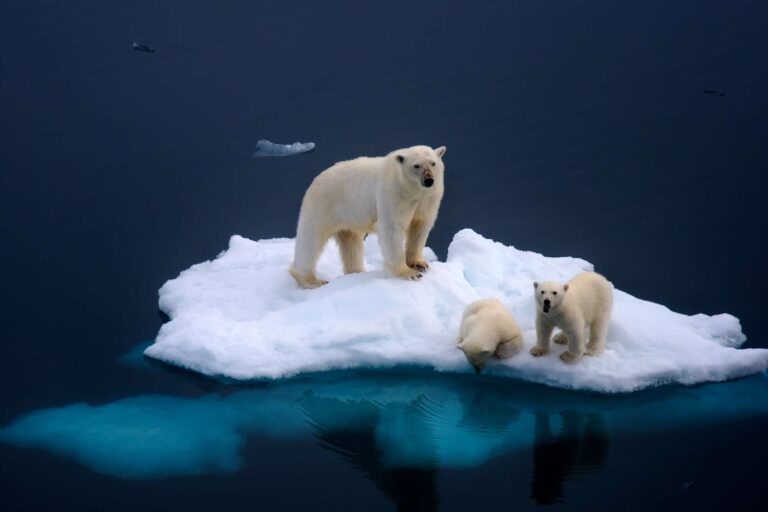
Those are the ones you know to watch. And soon enough the people around you begin mumbling in excitement. There’s a Polar Bear, a big one, and he’s coasting in the waters around th e seals. A marine animal, he is as at home in the water as they are, but he knows that it’s on land, on the surface of the ice, where they’re most vulnerable. He chooses his prey, a seal on his own, a little away from the group. Part of your conscience wishes you could warn him, but from up here on deck you know that this is the hard reality of life above the Arctic Circle.
The sun is bright and for a moment the bear disappears. Everyone falls silent. And it’s his sudden movement that breaks the calm, springing from the water and grabbing the seal with a casual cruelty that makes you shiver, even as you stare in wonder at the sheer power of the animal. Shutters click, people mumble in astonishment and, as the bear begins to feed on the thick fat that will help him survive the coming winter, you marvel at all that the Arctic wilderness has in store.
Although I was lucky enough to witness this while working on a twelve night Around Spitsbergen holiday, Polar Bears are visible across the Arctic. But whether on a two night Polar Bear Country Adventure in northern Manitoba, or on a ten night Spitsbergen Explorer holiday, seeing a Polar Bear is always an amazing experience…even for those of us who spend the whole season up north in search of them!
Posted on February 25, 2013 in Arctic , Canada , Ships , Travel , Wildlife | Permalink | Comments (0) | E-mail this
Whale-Watching on Humpback Feeding Ground
Natalie Swain, part time marketing executive at DTW/part time Polar Guide (lucky girl!), shares her experience of Humpback encounters in the Arctic.
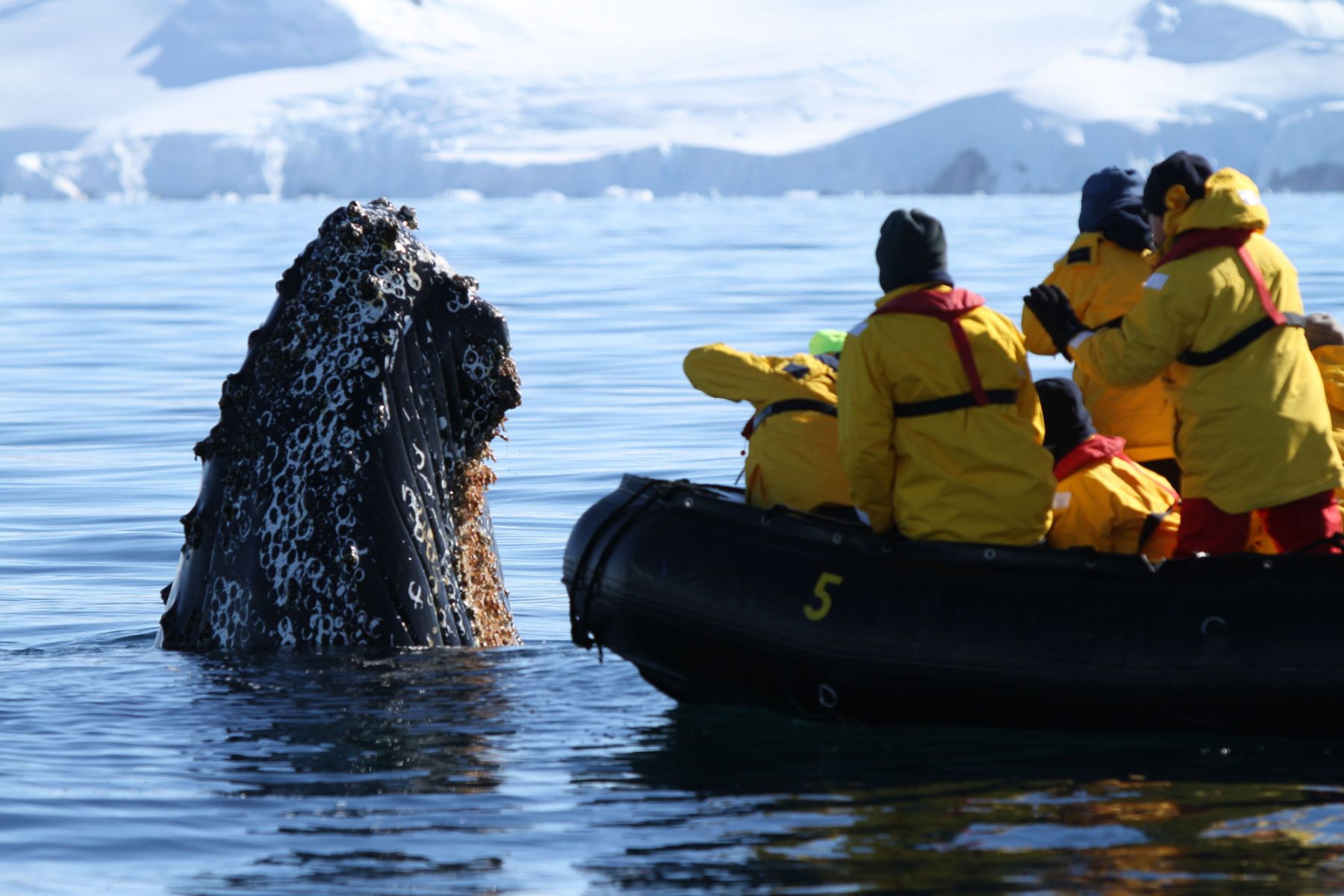
There is nothing quite like the sight of a Humpback whale on the horizon, the jet of air shooting high into the Arctic sky. As our vessel approached closer, pressing through small pieces of ice that sparkled in the midnight sun, it was well past our bedtime, but no one on deck was thinking of going to bed. As the ship got closer we could see the rising hump of the appropriately named Humpback, followed by a clean show of his tail. Each tail is distinct and after a close inspection we could all see that this whale was different from the one who came up a few minutes before. In another minute, a third whale surfaced, this time breaking the surface entirely and showing off its long, lean body in a breach before coming down hard in a belly flop on the ocean’s surface.
As our ship came alongside, cameras snapping and travellers gazing in wonder, the rising bubbles of the humpback’s breathe preluded the sight of their bodies, shadows that twirl beneath the ocean’s surface as they follow the air-bubbles to the surface. This is a common Humpback hunting technique and by working in pairs and releasing bubbles in a long, even breath, the magnificent animals trap the resident fish within the helix of air through which the little animals can’t swim. The large mammals then circle underneath and swim through the bubbles, mouths open, and enjoy a feast of fresh seafood.
These magnificent animals can be seen pole-to-pole and displays of this kind can keep polar travellers on deck for hours as the magnificent sea creatures play and feed until memory cards are full. This was exactly what some of our 2012 visitors to Spitsbergen witnessed last year while sailing on a ten night Around Spitsbergen odyssey and I’ll be heading north again this year eagerly hoping for a similar encounter. You can also these aquatic wonders down South on the nine-night Antarctic Whale Safari. But regardless of where you go in pursuit of these amazing animals there is no doubt that viewing them at sea is one of the most rewarding wildlife encounters I have ever experienced.Posted on February 20, 2013 in Antarctica , Arctic , Client Stories , Photography , Ships , Travel , Wildlife | Permalink | Comments (0) | E-mail this
Spying on Penguins with the BBC
I couldn't resist sharing this trailer for the latest wildlife offering from the BBC - it's indisputable proof, penguins really are among the most comical and endearing creatures on the planet!
'Penguins - Spy in the Huddle' offers fascinating new footage of a variety of penguin species, filmed via 50 hidden cameras over the course of a year. Don't miss the first episode, airing on Monday 11 February at 9pm, on BBC1.
Posted on February 6, 2013 in Antarctica , Television , Travel , Wildlife | Permalink | Comments (0) | E-mail this
Antarctica: The BEST Journey in the World
From a leisurely stroll around the "quintessential English Edwardian seaside town" of Stanley, Falkland Islands, to battling against 180mph winds in South Georgia, DTW client Lesley Shane certainly had an epic adventure on the Ocean Diamond's inaugural Antarctic voyage. Sailing in early November on our Peninsula, Falklands & South Georgia expedition, here's just a short excerpt from Lesley's fascinating travelogue:
"I must admit to being a bit anxious about going off for three weeks to Antarctica, almost on a whim. Would the 'expedition' just be a cruise by another name, would I get seasick, would I get too cold, would it not live up to my expectations, would I be lonely? All the answers are a resounding no. It was simply AMAZING... Antarctica is absolutely beautiful, wild, awe-inspiring… totally and utterly unspoilt, unpredictable and everything I could have hoped for.
One of the many highlights was South Georgia - seals and king penguins, birds and more seals. An incredible experience to be in the midst of all these marvelous creatures that were totally unafraid of humans. If there were legs in the way of a seal they just slithered over them. King penguins checked out our cameras and then went and posed for yet another photo opportunity. Tiny new born elephant seals covered in black glistening fur, mothers feeding their pups; giant, terribly scarred bull elephant seals occasionally thumping each other’s chests and roaring just on principle. Young penguins in furry coats and full grown ones with their smooth impeccable feathers gleaming in the sunlight. Hundreds of thousands of them, as far as the eye could see…
Our most incredible experience though was in Petersen Bay, Antarctica, when two orcas decided to hunt a crabeater seal. They isolated the seal on an icefloe and worked in tandem diving under the water about 50 metres from the seal, flipping their tails to cause a large wave which washed the seal off the ice. The seal however was really speedy and kept flipping back onto the ice faster than the orcas could turn and grab her. Again and again the orcas tried to get the seal off balance; it went on for at least 15 minutes while the seal was getting more and more tired and the ice floe getting smaller and smaller... Finally the seal timed it perfectly and as the orcas were at their furthest point she slipped out of the back door and was gone, gone, gone. And oh how we cheered! It was simply the most amazing experience and we are so fortunate to have been in the right place at the right time.
This voyage was truly an experience of a lifetime for me, and one which I would not hesitate to do again. When does the next ship south leave I wonder?"
Posted on January 25, 2013 in Antarctica , Client Stories , Ships , Travel , Wildlife | Permalink | Comments (0) | E-mail this